The Irish Expedition to Everest, 1993
Charles Howard-Bury holds a special position in the history of Irish mountaineers.
In 1987, an Irish expedition climbed the North Col of Everest several times in attempting to
make the summit of Chang-tse. However, soft snow conditions and bad weather prevented the team reaching
the summit. Yet six years later, Dawson Stelfox would stand on the summit of Mount Everest, as part of another Irish expedition.
On both occasions, the expeditions traversed some of the same routes as Howard-Bury and the 1921 reconnaissance mission to Mount Everest.
In 1987, an Irish expedition climbed the North Col of Everest several times in attempting to
make the summit of Chang-tse. However, soft snow conditions and bad weather prevented the team reaching
the summit. Yet six years later, Dawson Stelfox would stand on the summit of Mount Everest, as part of another Irish expedition.
On both occasions, the expeditions traversed some of the same routes as Howard-Bury and the 1921 reconnaissance mission to Mount Everest.
|
Getting ready
The Irish party in 1993 consisted of eight climbers: Dawson Stelfox, (leader); Frank Nugent (deputy leader); Dermot Somers, Robbie Fenlon, Mike Barry, Richard O'Neill Dean, Mick Murphy and Tony Burke. This was the first Irish attempt on Everest and members were from both the Republic of Ireland and Northern Ireland. The trip was supported by the Mountaineering Council of Ireland (MCI), the Sports Councils in Dublin and Belfast and financed by Irish companies and fund raising events.
The team left Ireland for Kathmandu on 17 March and, after an acclimatisation trek in Nepal, crossed the border at Zhangmu into Tibet on 28 March. Snow-blocked roads made for a slow approach and it was 2 April before base camp was established, tucked under the tip of the Rongbuk glacier at 5170m. The advance base camp was established at 6450m at the top of the East Rongbuk glacier on 7 April, all supplies being carried up by yak. The first trip to the North Col was on 11 April. The snow was in good firm condition though the route was threatened by alarmingly overhanging seracs (a block or column of glacial ice, often formed by intersecting crevasses on a glacier, which may topple with little warning). Fortunately, there were no serac collapses but the snow conditions gradually deteriorated and during the final descent off the mountain at the end of May, only the fixed ropes prevented climbers being swept away by small fresh snow-avalanches. Despite the arduous trek up the East Rongbuk glacier, climbers returned on two or three occasions to base camp, the lower altitude speeding up acclimatisation. Camp 2 was established at 7700m on the rocky north ridge. Other sites above this are possible, but the team found the climb up from the North Col very taxing and settled for the lower site. This whole area is exposed to strong westerly winds which almost continuously swept across the North Face and it lost two tents and numerous poles at this camp. Winds and unsettled weather prevented progress beyond this point until 16 May when a strong attempt to establish Camp 3 reached 8200m, only 100m below the intended site. Meanwhile on 11 May, 1 Chinese, 1 Taiwanese and 4 Tibetan Sherpas reached the summit but made an epic descent, all but one suffering severe frostbite and some surviving only by the Irish team's offer of oxygen and stoves at 7700m. Top of the World
The weather continued cold, windy and unsettled through most of May, and although the team was able to fully stock Camps 1 and 2, it was impractical to make a summit attempt until 23 May. Frank Nugent and Dawson Stelfox left Advanced Base Camp on 24 May, supported by Mike Barry and Khunke Sherpa. The following day they climbed to Camp 2 and Robbie Fenlon, Tony Burke, Mick Murphy and Dendi Sherpa left Advanced Base Camp to follow up on a second summit attempt. Strong winds forced a halt on 25 May, but on the following day Nugent and Stelfox established Camp 3 on a snow slope below the crest of the ridge at 8300m amongst the wrecked tents of previous expeditions.
Nugent and Stelfox left Camp 3 at 5.00 am on 27 May, reaching the crest of the ridge at 7.30 am, slowed by deep snow and difficult route finding in the dark. The initially easy snow ridge led onto steep rock, covered with a thin layer of powder snow and there were few traces of old ropes. The traverse around the first rock step was awkward and the climbing grew progressively more difficult. Nugent was having increasing problems with his oxygen system, struggling to get sufficient air for the demanding ground. At 8680m, he decided to turn back and made a cautious descent to Camp 3 alone. The ridge at this point is narrow and pinnacled, guarded on the east by large cornices - the best line a delicate traverse on steep slabs 20m below the crest on the northern side. The Second Step was well equipped with old fixed ropes and the 1975 Chinese ladder up the final 8 m was still precariously in place. Beyond the step the climbing eased, the route crossing a broad boulder-strewn ridge to reach the Third Step at the top of the Great Couloir. Now in thick cloud and light snow, Stelfox completed a rising traverse rightwards across a 50 degree snowfield and then up more slabs to the steep rock buttress guarding the summit. A ramp line led back left onto the summit ridge, about 200m from the top. The weather cleared again, cloud descending into the valleys and Stelfox reached the summit about 5.00 pm, twelve hours after starting out. There was little wind and the views were extensive. No-one else was on the summit and clear radio communication was established to base camp. After 30 minutes on the summit, he started to descend. Fresh snow at the top of the Second Step caused problems trying to locate the top of the ladder as tracks had been filled in. Oxygen ran out soon after and darkness overcame him at the point of leaving the ridge above Camp 3. He reached Camp 3 by torchlight at 11.00 pm, the descent taking 6 hours. Fenlon and Burke had reached Camp 3 that day and made their summit attempt the following morning, reaching 8500m before strengthening winds and increasing cloud forced them to return to Camp 3. All four climbers then started the descent, dismantling camps en-route. Within a few hours it was snowing hard but they all reached the North Col by 6.00 pm. Burke remained there and descended the following morning but the others carried on down to advance base camp in white-out conditions, reaching there after dark. Details of the expedition taken from the Himalayan Journal, volume 50 |
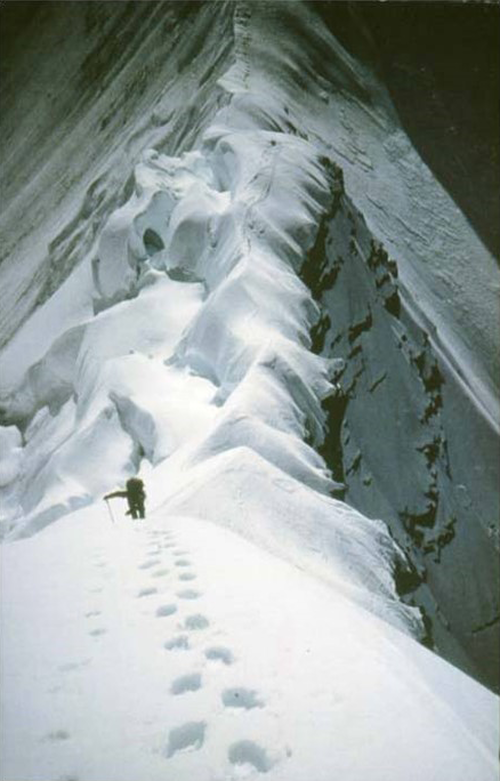
Phil Thomas climbing the South Ridge of Chang-tse in 1987
(Frank Nugent Collection) 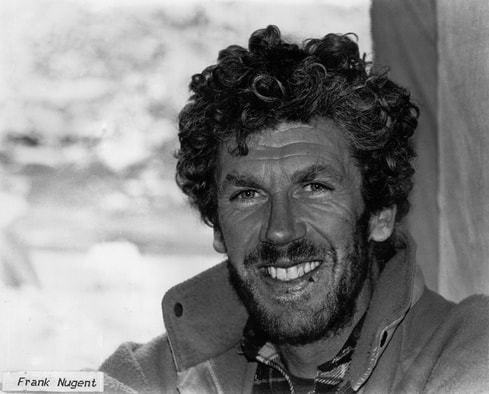
Frank Nugent in 1987 (Frank Nugent Collection)
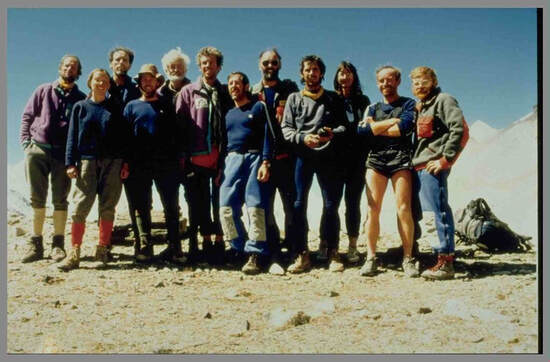
The 1987 Irish expedition to Changtse (Frank Nugent Collection)
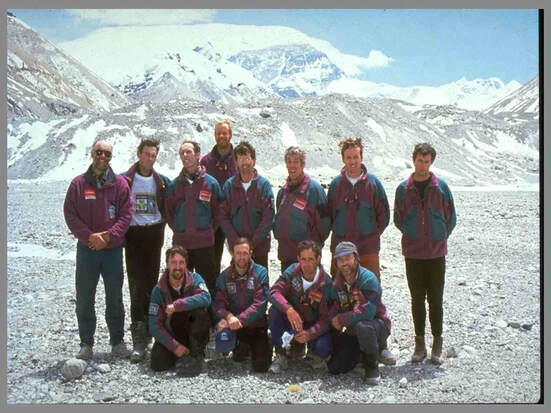
The 1993 Irish expedition team (Frank Nugent Collection)
|
|
Mount Everest holds many dangers,
especially for inexperienced climbers |
Frank Nugent discusses acclimatisation and the use of
supplementary oxygen when climbing Mount Everest |
|
|
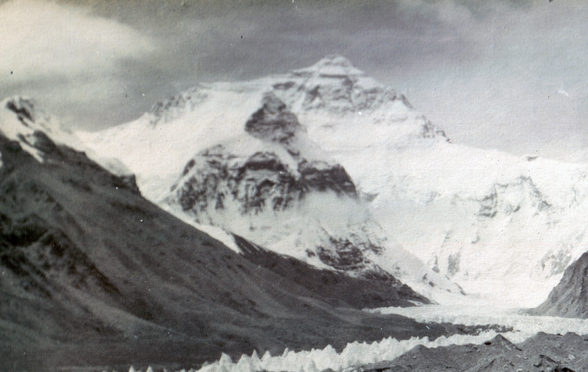
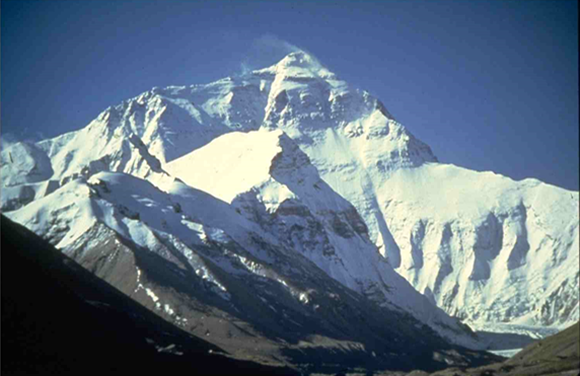
The 1993 expedition closely followed the 1921 reconnaissance team's route along the Rongbuk glacier, as can be seen in these photos taken 72 years apart.
The photo on the left is provided by Marian Keaney/Westmeath Library Services, the photo on the right was provided from the Frank Nugent Collection.
The photo on the left is provided by Marian Keaney/Westmeath Library Services, the photo on the right was provided from the Frank Nugent Collection.
On 27 May 1993 Dawson Stelfox reached the summit of Everest, as described by Frank Nugent