Fame and Politics
Following Howard Bury’s return from the Everest
reconnaissance expedition, he turned his attention to forming
a political career in the United Kingdom with the Conservative Party.
reconnaissance expedition, he turned his attention to forming
a political career in the United Kingdom with the Conservative Party.
The final end of every Irishman is to have a united Ireland. It cannot come by pressure or by force from outside. It cannot come by force or by compulsion from inside. It will not come immediately. Memories of murders and outrages are still too fresh. It will take many years before the two parties can forget. Time alone can soften. Perhaps it may not even come in our lifetime. But come one day it will. It is bound to come, but it can only come by a policy of good will between the Northern and Southern Governments, and by a full appreciation of the difficulties that each has to undergo. If the North will show good will towards the South, and the South can show that they can govern firmly and justly without partiality, favour, or affection, then, I believe, the time for the unity of Ireland is not so far off. An island divided against itself can never prosper, and Ireland is not such a very big island after all, though its influence extends to nearly every country in the world.
An excerpt from Charles Howard-Bury's first speech to the British House of Commons,
29 November 1922, during a debate on the Irish Free State Constitution Bill.
|
Victories and Losses
Charles Howard-Bury entered British politics soon after returning from the Everest expedition. His name was widely-known and his exploits in Tibet were a prominent part of his election literature.
On 15 November 1922, Howard-Bury was elected as a Conservative Party candidate for the constituency of Wolverhampton Bilston, although he was forced to defend the seat six months later. In May 1923, the prime minister, Andrew Bonar Law, resigned due to illness and was replaced by Stanley Baldwin, who called a snap election in December of that year. On that occasion, as in November 1922, Howard-Bury defeated trade unionist and Labour Party candidate John Baker. The December 1923 election resulted in the UK's first Labour Party government, with Ramsay MacDonald as prime minister. MacDonald oversaw a minority government that lasted only until October 1924. This time, Baker finally defeated his Conservative opponent and Howard-Bury lost his seat. He then tried to get elected to the Irish Seanad (the upper house of the Irish parliament) in 1925. The 1925 election was unusual in that the entire territory of the Irish Free State was used as a single, nation‐wide constituency for the election of senators - by means of the single transferable vote system of proportional representation from a general electorate. In that election, 19 seats were contested by 76 candidates. Howard-Bury, a non-party candidate residing in Westmeath, was expected to gather support from ex-servicemen in the British army but he was eliminated in an early count. With that election defeat behind him, he turned once again to the UK. In November 1926, he contested a by-election in the Chelmsford constituency in Essex, considered a safe seat for the Conservatives. Howard-Bury duly won, defeating Liberal candidate Sydney Robinson and he retained the seat in the 1929 general election. |
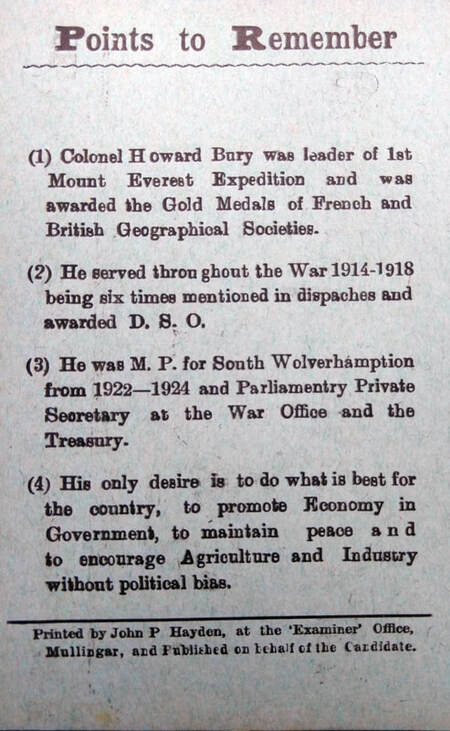
Canvassing notes for Howard-Bury during his 1925 run for the Irish Senate.
He was not elected. (Marian Keaney/Westmeath Library Services: Howard-Bury Collection) |
We have to realise that the army in India must remain there. I think even the most advanced Swarajist [a reference to the Swaraj Party: an Indian political party established in late 1922 by members of the Indian National Congress] realises that the growth of a self-contained and self-governing Indian nation is dependent on the strong arm and guidance of Great Britain. I think even the most advanced Swarajist will admit, though he will not like to admit, that he cannot get on without the British army.
Howard-Bury in the British House of Commons, 17 June 1927.
He opposed Indian efforts to achieve self-government.
|
'an economic united states of Europe'
During his parliamentary career, Howard-Bury spoke occasionally on Ireland and Irish topics. For example, during the Irish Civil war he urged the British government to support the Free State (29 November 1922): 'I would ask this Government to do all that it can to ensure that the New Free State Government is set up firmly on its legs and to give it all the sympathy it can in the great difficulties that surround it at the present time.' In the same speech, he lamented that British attitudes and policy flowed from ignorance: 'The English Press ignores the difficulties, and by their sins of omission they have brought about a state of feeling in which people do not understand what is happening in Ireland.'
Yet his greatest concerns were what he saw as the interrelated issues of geopolitics, Indian efforts to gain independence, and the security of the British Empire. Although he conceded that Indians should have 'racial equality within the Empire' (18 December 1929), he opposed Indian self-government and his attitudes to India were often framed in terms of racial stereotypes. During the same speech, he said of Indians: 'Educate them slowly up to the time when it may be possible to give them full self-government, but it will have to be a slow process.' Such sentiments were a recurrent theme in his parliamentary interjections on the topic of India. It was an 'Anglo-Saxon characteristic to go surely and steadily' (17 June 1927) whereas Indians were, in his view, running before they could walk. In his skewed and ignorant version of Indian history, it had been a backwater for a millennium: 'India for a thousand years did not advance' (18 December 1929). In a later speech, made a month after Mohandas Gandhi completed his Salt March in protest against British rule in India, Howard-Bury claimed that the British Empire 'brought wealth and prosperity to that country' (26 May 1930). Unable to comprehend the validity of Indian grievances and aspirations, Howard-Bury judged that 'Bolshevist propaganda' (17 June 1927) was the root cause of British troubles in India. When addressing other topics, particularly international relations, Howard-Bury was especially wary of the Soviet Union, not only because of its often brutal internal policies and what he perceived as its efforts to destabilise the British Empire but also because of its trade policies. He believed that Britain was being taken advantage of by the Soviet Union. On this issue, he also was critical of the United States of America, attacking its tariff policy during the late 1920s (which led, after the Wall Street Crash of 1929, to the Smoot-Hawley Tariff Act in 1930). Indeed, on 23 July 1929, he asked the President of the Board of Trade 'whether he will get in touch with foreign Ministers of Labour and Commerce in Europe and discuss the possibility of the formation of an economic united states of Europe as the only means of fighting the high American tariffs?' Howard-Bury's parliamentary career came to an end in 1931. That year brought another general election but, having recently inherited Charleville Castle, he opted against defending his Chelmsford seat. That decision marked his retirement from political life. Howard-Bury would, as his friend William Teeling wrote (London Times, 24 September 1963), remain steadfast in 'his loyalty to the British Crown'. His future, however, lay in Ireland and Belvedere House, where he would be an 'ambassador of goodwill'. |
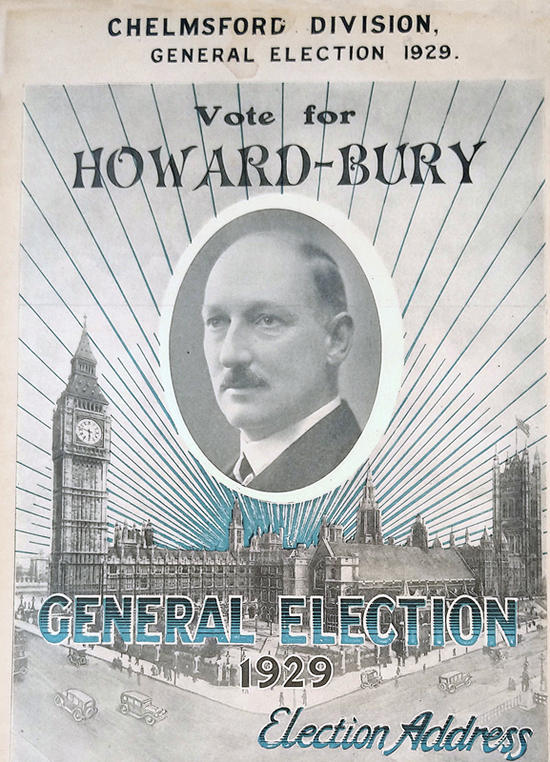
An advertisement for Howard-Bury’s 1929 election campaign
in the UK's Chelmsford constituency (Marian Keaney/Westmeath Library Services: Howard-Bury Collection) |